Skip to content

Custom software in Brisbane

Custom software shaped around how your business works.

When off-the-shelf tools force your team into workarounds, a system built around your process gives those hours back. We map how work moves through the business, then build the internal tools and connections that take the manual steps out.

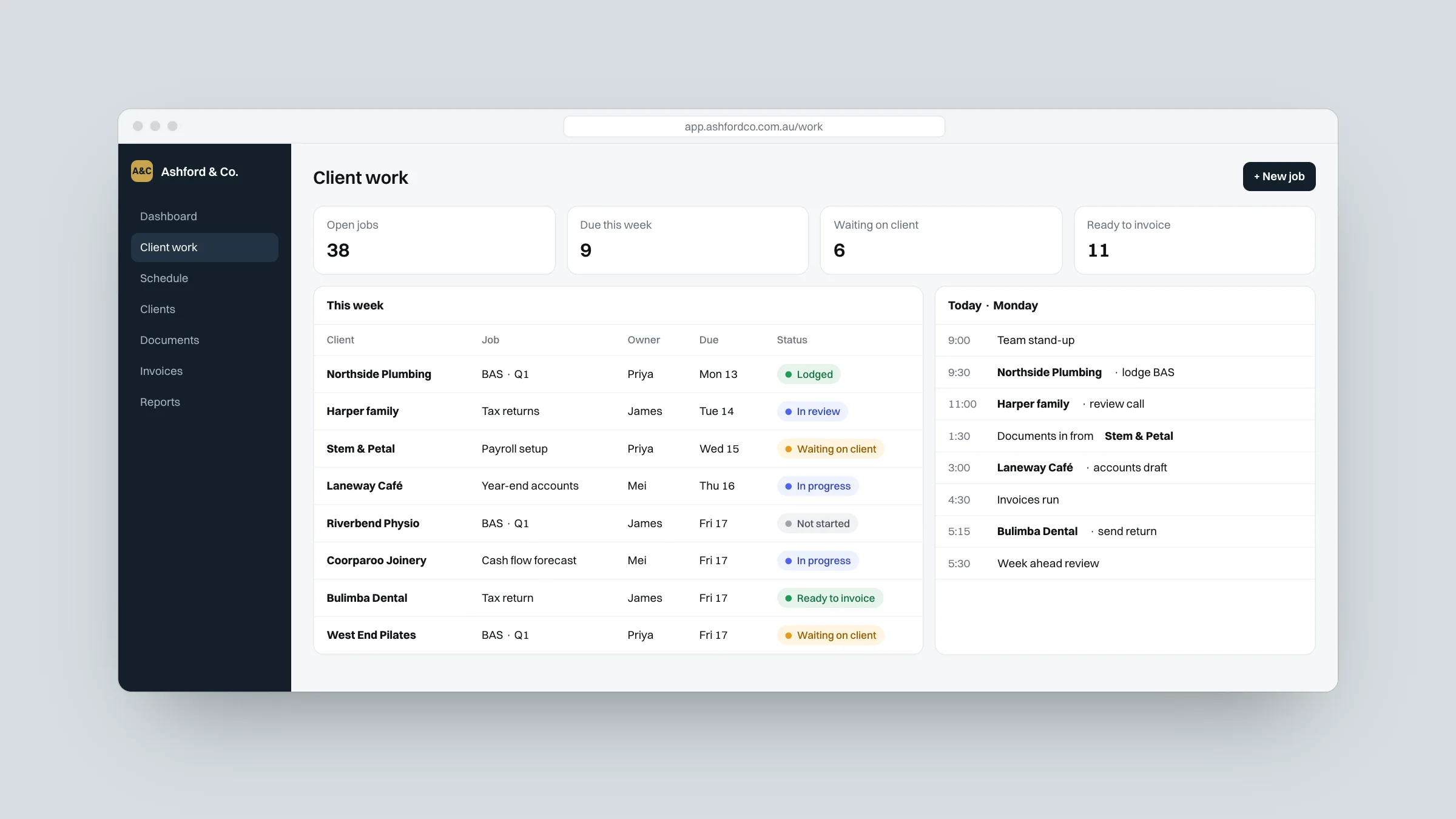
Example business system: a client work dashboard with open jobs, owners, due dates and status

Custom software

What’s included

  1. 01

    Internal tools

    Admin panels and job, quoting and scheduling tools designed for the people who use them all day. Fewer clicks, clearer screens and no re-typing.

    Admin panels · Job management · Scheduling

    Learn more
  2. 02

    Business systems

    Operational platforms that bring customers, jobs, stock or bookings into one place, with the reporting you need to run the business.

    Operations platforms · Customer records · Access control

    Learn more
  3. 03

    System integrations

    Connect the website, accounting, calendars, CRMs and payment tools you already pay for, so information is entered once and moves on its own.

    Accounting · Calendars & CRMs · Payments

    Learn more
  4. 04

    Data migration

    Move records out of spreadsheets and older systems into a clean, structured database, checked and reconciled before the switch.

    Spreadsheet migration · Legacy systems · Reconciliation

    Learn more
  5. 05

    Reporting dashboards

    Live views of the numbers that matter, built from your own data instead of exported and assembled by hand every week.

    Live dashboards · Custom reports · Data exports

    Learn more

Signs you’ve outgrown spreadsheets and off-the-shelf tools

  • The same details get typed in two or three times

    A job goes into a spreadsheet, then the accounting software, then a calendar. Every copy is time lost and a chance for a mistake.

  • One person holds the process together

    If a key spreadsheet only makes sense to one staff member, the business stops when they are away.

  • Your tools don’t talk to each other

    Quotes in one place, jobs in another, invoices in a third, and nobody can see the whole picture without exporting and assembling it.

  • You pay for software you work around

    An off-the-shelf product covers 70% of what you need, and your team fills the gap with workarounds every day.

  • Reporting takes a day every month

    If someone spends hours pulling numbers together by hand, a live dashboard pays for itself quickly.

  • Growth is making it worse

    More staff, locations or jobs make manual processes slower and more error-prone, not faster.

Is custom software right for you?

A good fit if

  • A repeated process costs your team hours every week
  • Existing tools force workarounds, or can’t be connected
  • You want the system to match how your business actually works
  • You want to own the software and your data
  • You can give us a person who knows the process to work with

Probably not the right fit if

  • An existing product fits your process well. Use it, and we will say so
  • The process is still changing every month. Settle it on paper first
  • You need it for a handful of uses a year. The cost won’t pay back

Spreadsheets, off-the-shelf or custom?

SpreadsheetsOff-the-shelf softwareCustom software
Upfront costAlmost nothingLow: monthly subscriptionsA fixed quote for the build
Ongoing costStaff time and errorsPer-user fees that grow with the teamHosting and a support plan
Fits your processYes, until it breaksYou adapt to itBuilt around it
Connects to other toolsManuallyOnly the connections it offersWhatever you need
Scales with the businessPoorlyUsuallyYes, by design
Who owns itYouThe vendorYou
Best forEarly days, small volumesStandard processesProcesses that set you apart or cost real hours

What you get

What you have at handover.

  • A mapped workflow and agreed first release
  • The system, live and in use by your team
  • Existing data migrated and checked
  • Code, documentation and handover

You own it.

The code and intellectual property transfer to you on final payment, into your own repository.

Documented.

Every build is handed over with documentation, so your team or another developer can maintain it.

Supported in writing.

A written agreement defines what we maintain after launch and the response times you can expect.

How it runs

How a custom software project runs

Fixed scope and price before work starts, working results to review at every stage, and one team from first call to launch.

  1. Weeks 1–2

    Map the current process

    We sit with the people who do the work, map how jobs, quotes or records move today, and mark every place something is re-typed, lost or waited on.

  2. Weeks 2–3

    Design the first release

    We agree the one workflow the first release must fix, design the screens with the people who will use them, and confirm the fixed price and timeline.

  3. Weeks 3–8

    Build in stages

    The workflow, integration and dashboard built in two-week stages, each one reviewed by your team using real examples. Your existing data is imported, checked and reconciled.

  4. Weeks 9–10

    Switch over

    Staff training, a planned switch-over date, the old process kept available for a short overlap, and a 30-day warranty while the team settles in.

Packages

What you get

Every project is priced on its scope, with a fixed quote after a free 30-minute call, before any work starts.

Core system

Fixed quoteUsually 6–10 weeks

Book a free 30-minute call

Included

  • Scoping workshop: how the work happens today and where it breaks
  • One core workflow built around how you work
  • Up to two user roles plus an admin
  • One existing spreadsheet or dataset imported and cleaned
  • One integration, such as accounting software or a calendar
  • A simple dashboard with up to 5 key numbers
  • Hosting in your accounts, with backups and monitoring
  • Staff training, documentation and a 30-day warranty

Not included

  • Subscriptions for the tools we connect to
  • Cleaning more than one dataset
  • Hardware
  • 24/7 support (business-hours care plans are available)
Add-ons
  • Extra integration
  • Extra dataset imported and cleaned
  • Staff mobile app
  • Custom report

What moves the price

  • Workflow depth

    A straight-line process costs less than one with approvals, reversals and exceptions.

  • Roles and permissions

    Every extra role needs its own screens, rules and testing.

  • Integrations

    Each connection to accounting, calendars, payments or CRMs brings another company’s rules and failure cases.

  • Your data

    Clean spreadsheets import quickly. Years of inconsistent records across several sources take real work to reconcile.

Example: The Butcher is the Chef

A loyalty system that runs on a phone number

A loyalty programme for an independent butcher, built around how the counter actually works: staff record a purchase against a customer’s phone number, points and rewards update automatically, and there are no cards or apps for customers to lose.

Read the case study

Related work

Built and in production.

Where we work

Questions about custom software

View all articles

Free guide

Is your website quietly losing you enquiries?

A free guide to the seven reasons small business websites don't bring in work, with a two-minute check and a practical fix for each. What's inside

We'll only use your email to send the guide and these tips. See our privacy policy.

Questions

Frequently asked questions

How much does it cost?

Custom software is priced on its scope: the workflows, the user roles, the data that needs importing and the systems it connects to. You get a fixed quote after a free 30-minute call, before any work starts.

How long does it take?

Core system: usually 6–10 weeks. We confirm the timeline with the quote, before any work starts.

Should we buy an off-the-shelf tool or build custom software?

If an existing product fits your process, use it. Custom software makes sense when the workarounds cost more than the build, or when the process itself is what sets your business apart. We give you an honest view in the free 30-minute call.

Can you connect the systems we already use?

Usually, yes. If a tool offers an API or data export we can connect it, so records created in one place appear in the others. One integration is included in the core system.

What happens to our existing data?

We import it into the new system, check it against the source and reconcile any differences before your team switches over. One dataset is included, and more can be added.

Can you take over software someone else built?

Yes. We start with a technical review of the codebase, hosting and documentation, then agree what to maintain, fix or rebuild.

How do you make sure staff actually use it?

By designing it with them. The people who do the work review every stage, so the finished system matches what they need, and we train the team before switch-over.

Is our data secure?

Access is limited by role, important changes are recorded, data is backed up and hosted in your own accounts, and we only collect what the system needs.

More services

The rest of the build.

Enquire

Talk to us about custom software.

Tell us what you are working on and what you need. An outline is enough to start. We reply within one business day.

Prefer email? hello@vareonhq.com